CueTurn
Designing how AI takes the floor in live group conversations.
The Premise
Gen AI is getting better at live conversation, but most systems still follow a familiar pattern: a person speaks, and the AI responds. CueTurn explored a different model:
How should AI intervene in a live group conversation?
That shift makes the interaction much more complex. The system must listen across multiple people, recognize when intervention is actually useful, and step in without breaking the group’s flow. Unlike a human facilitator, AI does not begin with shared social legitimacy. It has to earn trust in the moment while still being clear enough to influence the conversation.
We centered on anticipatory cues to test how they prepare the group for AI intervention, examining:
-
1
How anticipation signals shaped noticeability and perceived disruption
-
2
How timing and delivery style influenced participant response to AI intervention
The Prototype
CueTurn is a research prototype exploring how an AI facilitator can join live group conversations at the right moment, with the right level of visual intensity, without disrupting the group’s flow or sense of agency.
System overview
CueTurn was a working prototype tested in live group discussion sessions. The system included:
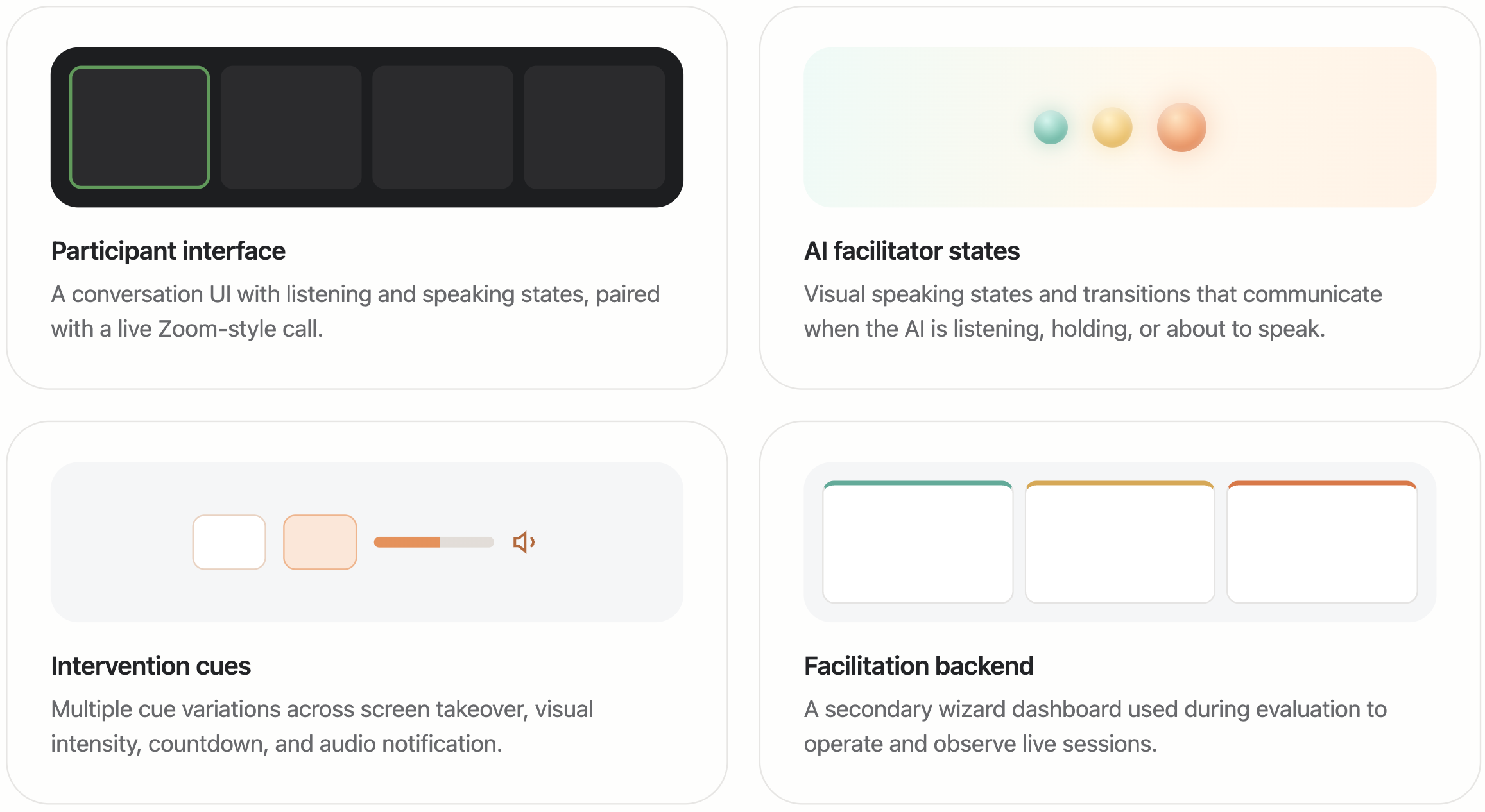
Process
Investigation 1: Anticipation signals
How can AI signal an upcoming intervention without feeling disruptive? To start, we designed the anticipatory period before the AI spoke as a sequence of stages:
Stages of speaking
To explore the relationship between noticeability and perceived disruption, we centered on screen occupancy, countdown explicitness, and audio notifications.
Design space
Investigation 2: Narrowing the design space
How can we turn a broad design space into differences people can actually perceive?
CueTurn began with an extensive design space, but we narrowed the space around how users experience the AI’s presence: how prominent, explicit, and intrusive each intervention feels. Countdown exploration shifted from visual form, such as ring vs. bar, to explicitness: visible numbers versus a less explicit timer.
Countdown form
Explicitness
Designing the experimental study
CueTurn's co-design structure (30-minute group discussion paired with a 1:1 follow-up interview) gave participants enough time to acclimate to an unfamiliar interaction model, reducing novelty effects and making their feedback on design differences more meaningful.
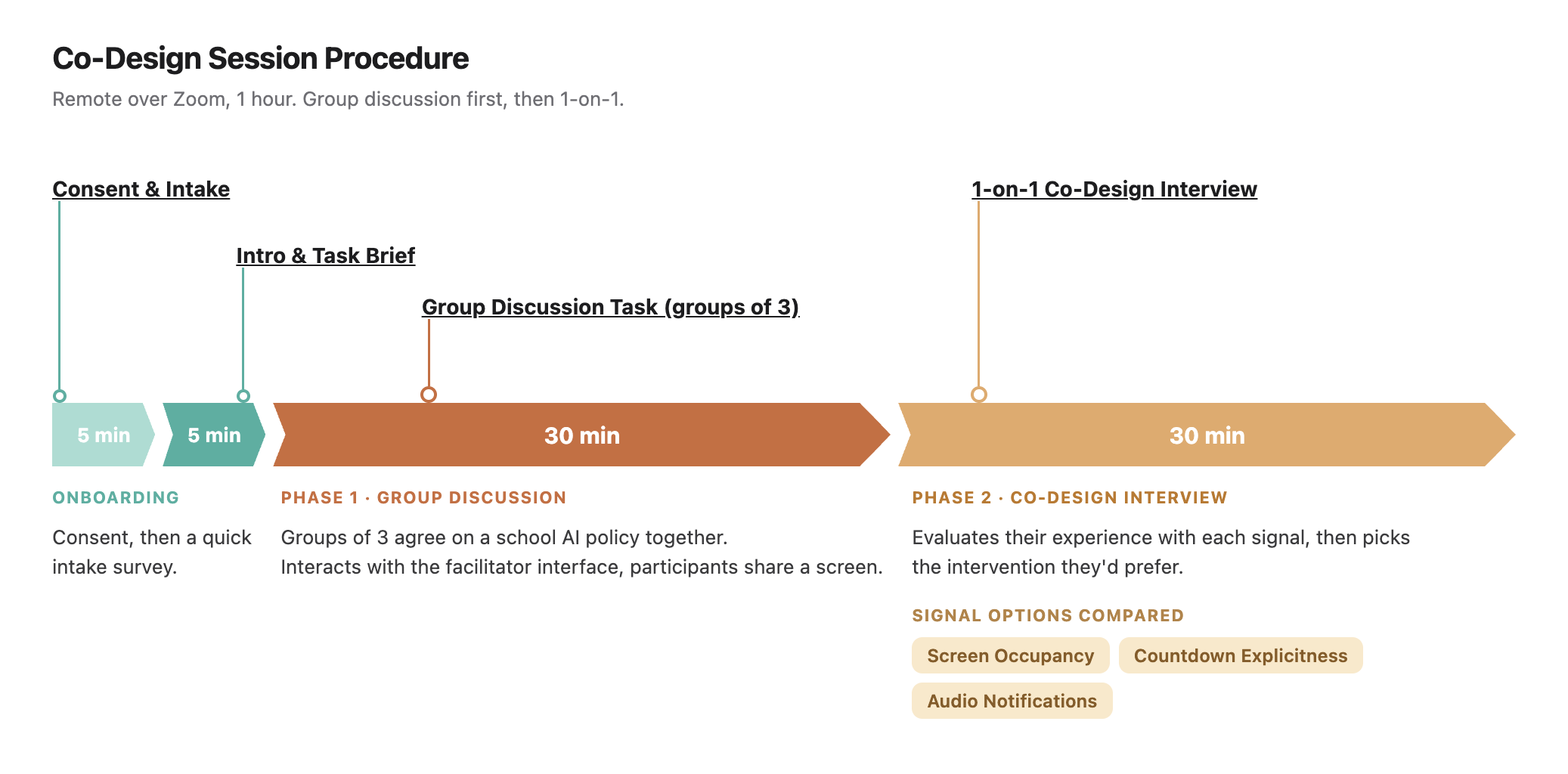
Wizard-of-Oz Setup
A trained facilitator operated CueTurn behind the scenes, while participants experienced cues as AI-generated.
The system generated candidate cues across social, content, and timing triggers; the wizard selected, edited, and sent them at natural pause points. This allowed us to isolate the intervention experience itself from inconsistencies in cue content or timing!
Emerging patterns
Notes from the live sessions were coded against the three anticipation variables, then clustered into interaction dimensions. Attention was the thread that kept showing up in how people described noticing — or missing — the cue.
Anticipation variables
Occupancy
Screen takeover
Sidebar glow
Countdown
With numbers
Without numbers
Sound signal
No sound
Single ping
Escalating ping
- Pain point
- Valued
- Conditional
Interaction dimensions
User thoughts
Reflection
CueTurn is redefining how I think about product design for AI. Working on it made me much more aware of the behavioral layer of these systems: when they should step in, how strongly they should ask for attention, and what makes their presence feel trustworthy instead of disruptive.
It also pushed me to work across the full arc of a project, from interaction design and study design to live research and synthesis into product decisions. This process is shaping the kind of designer I want to become!